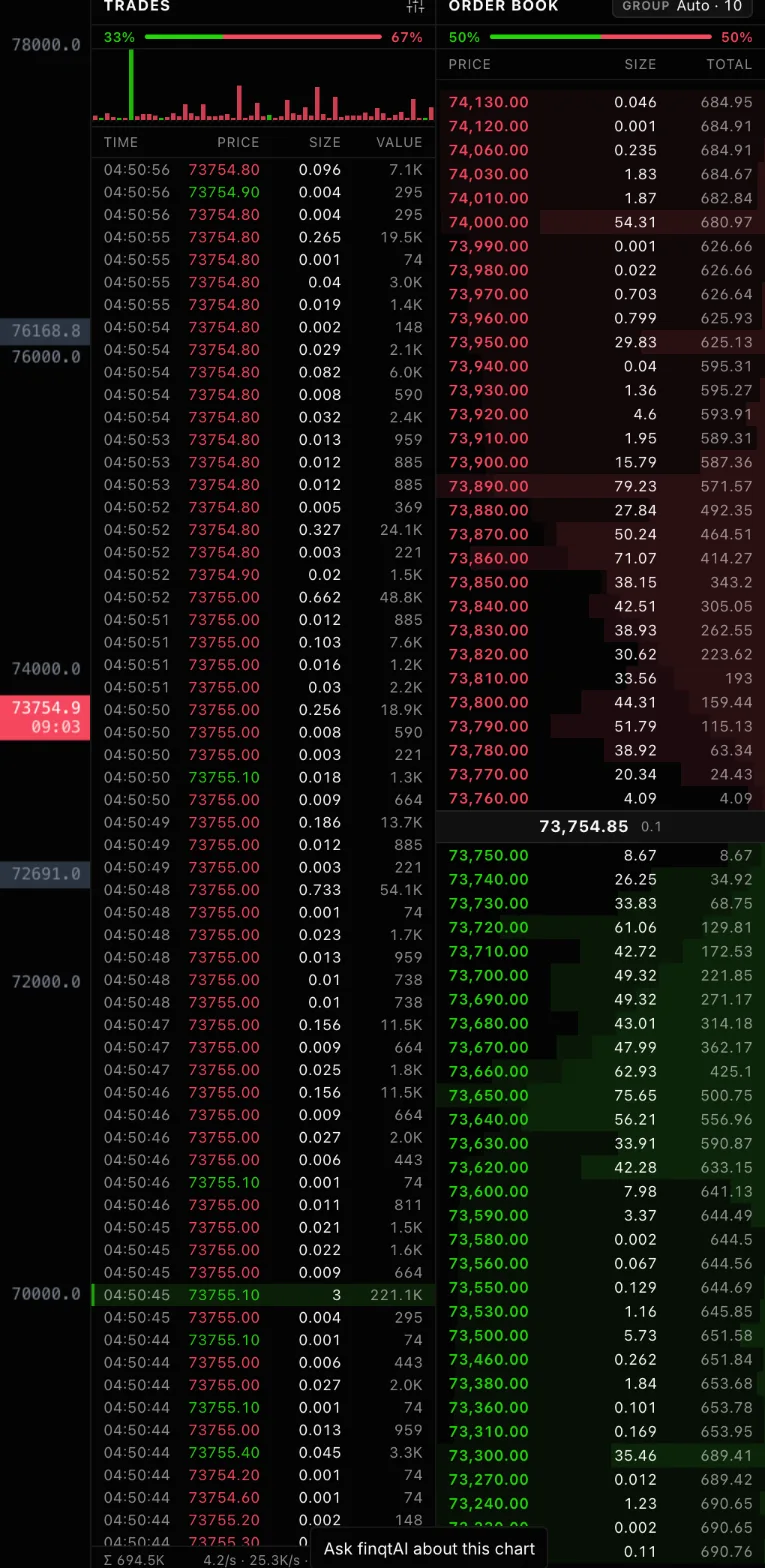
Real-time market data sounds like an obvious upgrade. Faster prices, fresher charts, less delay. Who would not want that?
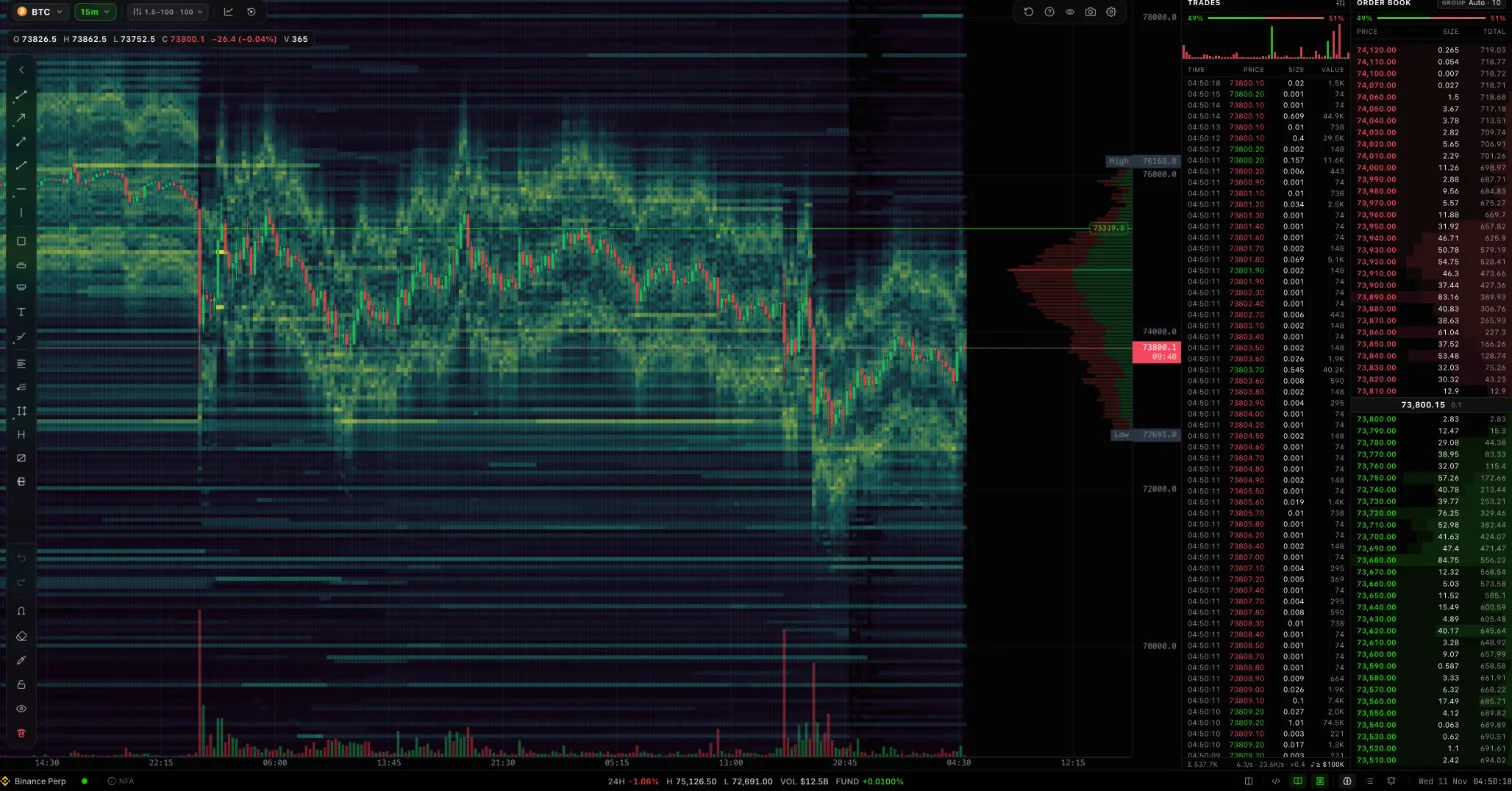 The finqt liquidity view: heatmap, volume profile, live trades and order book updating in real time
But speed is not the same as clarity. A one-second price feed can make you sharper, or it can turn your day into a reflex test you were never supposed to take. The difference is not the feed. It is the workflow wrapped around it.
This is the practical version: what real-time data actually changes, what it does not change, and how to use live markets inside finqt without letting every candle rent space in your head.
What delayed data quietly breaks
Delayed data is fine for slow research. If you are reading annual reports, comparing revenue quality, or studying a long-term allocation, a fifteen-minute delay rarely changes the conclusion.
It becomes a problem when you are trying to understand the market as it is forming.
Delayed data can break three things:
- Context. A headline lands, but the chart you are seeing is behind the actual reaction. You cannot tell whether the market ignored it, faded it, or repriced around it.
- Risk. A stop, alert, or invalidation level is only useful if the price around it is current. If the feed is stale, your mental model is stale too.
- Comparison. Cross-market reads depend on timing. If Bitcoin, NASDAQ futures, the dollar, and a high-beta stock are all updating at different speeds, correlation becomes guesswork.
Real-time data fixes those problems. It gives every part of your workspace the same clock.
That matters.
What real-time data does not fix
Live prices do not make a weak thesis stronger.
They do not tell you why something moved. They do not decide whether a breakout is clean. They do not replace position sizing, journaling, or the uncomfortable act of admitting you were wrong.
The dangerous version of real-time data is the one that makes every tick feel meaningful. Most ticks are not meaningful. They are inventory moving from one participant to another. If your process treats every update as a signal, your process will eventually train you into overtrading.
The point of live data is not to react faster to everything. It is to know when the market has crossed a level that already mattered before the tick arrived.
The three jobs of a live market workspace
A good real-time setup has three jobs.
1. Keep the main view honest
Your portfolio, watchlist, charts, and news should agree with each other. If a position is down because the asset just sold off, the chart should show that move. If an alert fired, the price should match the chart you are about to inspect.
This sounds basic, but it is where a lot of multi-app workflows fail. One tab updates, another lags, a third uses a different venue, and the investor is left reconciling software instead of reading the market.
2. Compress cross-checking
When something moves, the first question is not "what do I do?" The first question is "is this move isolated?"
If ETH breaks a level, what is BTC doing? If a semiconductor stock gaps, what are NASDAQ futures and its closest peers doing? If a crypto exchange token spikes, is the move showing up across the sector or only on one venue?
Real-time data is useful when it lets you answer those questions in one place.
3. Turn alerts into review points
An alert should not be an order. It should be a scheduled interruption.
The right alert says: "This is the price or condition where I promised myself I would look again." When it fires, you review the chart, the market context, the news, and your original thesis. Sometimes the review leads to action. Often it leads to nothing. That restraint is part of the edge.
A simple live-data loop
Here is the loop we recommend inside finqt:
- Set levels before the session. Mark the prices, ranges, or percentage moves that would actually change your view.
- Let alerts do the watching. Do not keep a chart open just because you can. If the level matters, let the system call you back.
- Cross-check context. When an alert fires, look at related assets, news, flow, and the broader market state before forming a conclusion.
- Ask finqtAI for structure, not permission. Use finqtAI to read the chart, summarize the setup, and surface what you might be missing. Do not ask it to make the decision for you.
- Journal the decision. If you act, write the reason. If you do not act, write that too. The skipped trades are part of the dataset.
This loop turns real-time data from stimulation into structure.
Where finqt fits
finqt is designed around the idea that live data should sit beside the rest of the decision context.
That means real-time prices, charts, market intelligence, AI-summarized news, alerts, watchlists, and the journal live in the same working surface. The point is not to make the app louder. The point is to remove the tab-switching that breaks attention when the market is already moving.
Real-time data matters most when it is connected to a thesis. Without that connection, it is just motion. With it, it becomes a clean trigger for review.
The bottom line
Live prices are not an edge by themselves. Everyone can see the price.
The edge is in what you prepared before the price moved, how quickly you can verify the context after it moves, and whether you can stay disciplined when the screen starts asking for attention.
Use real-time data to protect your process, not to replace it.